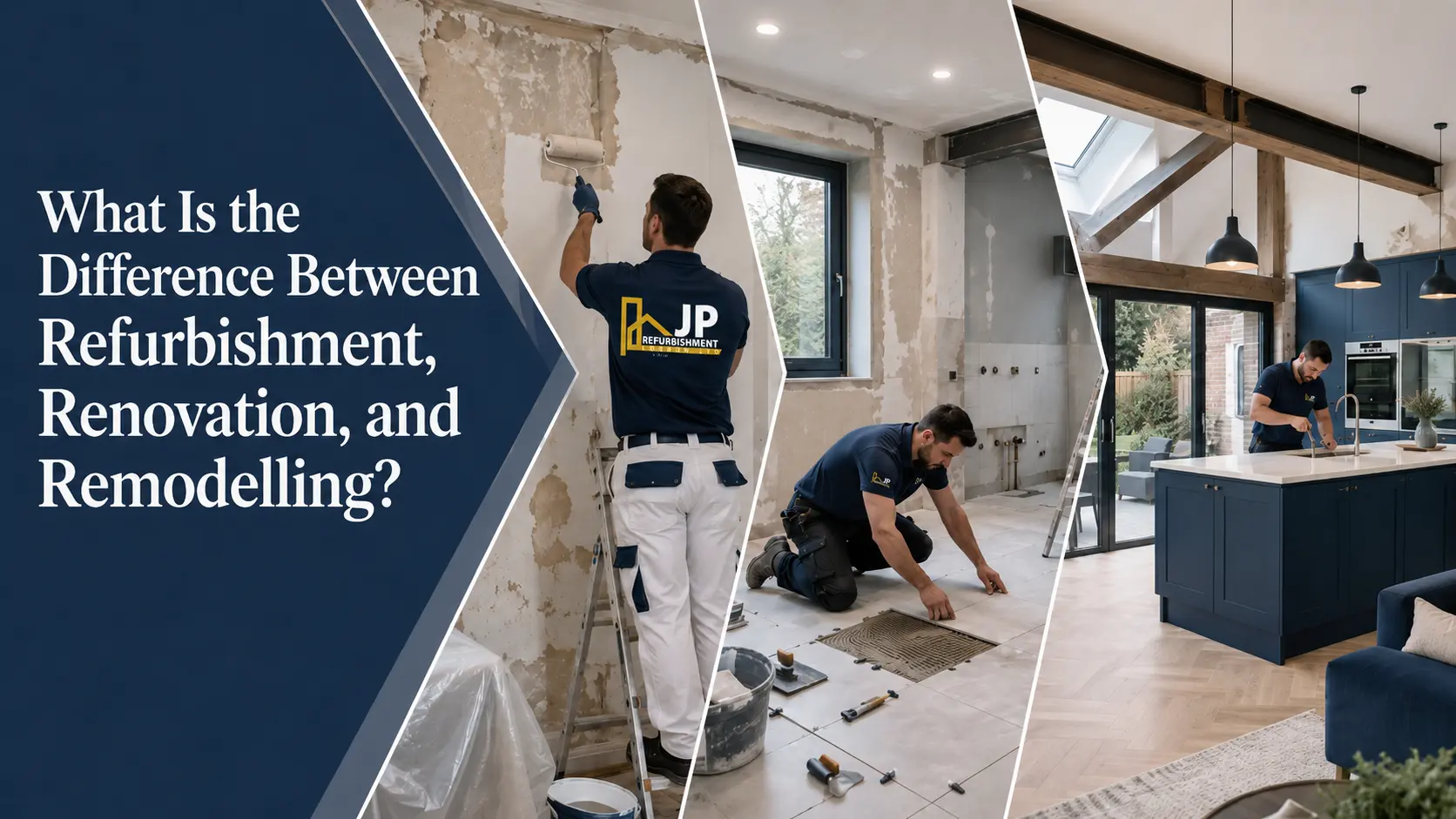
Refurbishment, renovation, and remodelling are often used interchangeably, but they describe different types of home improvement work. Refurbishment focuses on improving and updating a property, renovation restores a space to a good condition, and remodelling changes the layout, structure, or purpose of a room. Understanding the difference can help you plan your project more effectively and communicate your goals clearly to contractors.
Basic difference between refurbishment, renovation, and remodelling
All three terms involve improving a property, which is why they are frequently mixed up. However, each one has a different objective.
For example:
- Repainting walls and replacing flooring is usually refurbishment.
- Restoring a dated kitchen is typically renovation.
- Knocking down walls to create an open-plan kitchen is remodelling.
Many home improvement projects actually include a combination of all three.
What Is Refurbishment?
Refurbishment involves updating, repairing, improving, or modernising a property without necessarily changing its structure or layout.
The goal is to improve the property’s appearance, functionality, comfort, and value.
Common Refurbishment Work
- Painting and decorating
- New flooring
- Replacing doors and windows
- Kitchen upgrades
- Bathroom improvements
- New lighting
- Electrical upgrades
- Plumbing improvements
- Roofing repairs
- Landscaping
Refurbishment can range from minor cosmetic updates to complete property upgrades.
Example of Refurbishment
A homeowner updates an outdated bathroom by installing:
- New tiles
- A modern vanity unit
- New taps
- Better lighting
The room remains in the same location with the same layout, but it looks and functions much better.
This is refurbishment.
What Is Renovation?
Renovation focuses on restoring a property or room to a good condition.
It often involves repairing damage, replacing worn-out materials, or bringing an older property up to modern standards.
The goal is to renew and restore rather than completely redesign.
Common Renovation Work
- Repairing damaged walls
- Replacing old flooring
- Updating old kitchens
- Restoring period features
- Repairing roofs
- Replacing outdated plumbing
- Modernising electrical systems
Example of Renovation
A Victorian property still has its original kitchen from decades ago.
The homeowner replaces:
- Cabinets
- Worktops
- Appliances
- Flooring
The kitchen remains largely the same size and layout but is modernised and restored.
This is renovation.
What Is Remodelling?
Remodelling goes beyond updating or restoring.
It involves changing the structure, layout, or purpose of a space.
The goal is to create a completely different look, feel, or function.
Common Remodelling Projects
- Removing internal walls
- Creating open-plan living areas
- Converting a loft into a bedroom
- Turning a garage into a home office
- Reconfiguring bathroom layouts
- Moving kitchens to a different part of the house
Example of Remodelling
A homeowner removes the wall between their kitchen and dining room to create a large open-plan family space.
The layout and functionality of the property change significantly.
This is remodelling.
Refurbishment vs Renovation vs Remodelling: Key Differences
| Factor | Refurbishment | Renovation | Remodelling |
|---|---|---|---|
| Main Purpose | Improve and modernise | Restore and renew | Change layout or function |
| Structural Changes | Usually no | Rarely | Often required |
| Layout Changes | Minimal | Minimal | Significant |
| Property Use | Remains the same | Remains the same | May change completely |
| Cost | Low to medium | Medium | Medium to high |
| Complexity | Lower | Moderate | Higher |
| Planning Permission | Rarely needed | Sometimes needed | More likely to be required |
Which Option Adds the Most Value?
The answer depends on your property and goals.
Refurbishment Adds Value Through:
- Modern finishes
- Better functionality
- Improved appearance
- Increased buyer appeal
Renovation Adds Value Through:
- Restoring outdated areas
- Improving energy efficiency
- Fixing deterioration
Remodelling Adds Value Through:
- Better layouts
- More usable space
- Modern living arrangements
- Increased functionality
In many cases, remodelling projects such as loft conversions and open-plan kitchens deliver some of the highest returns because they improve how the property is used.
Which Is Best for Your Home?
Choose Refurbishment If:
- Your home feels tired or outdated.
- You want a fresh new look.
- The layout already works well.
- You want a cost-effective improvement.
Typical Projects
- Bathroom refurbishment
- Kitchen upgrades
- Decorating
- Flooring replacement
Choose Renovation If:
- Parts of your property are worn or damaged.
- You own an older property.
- Systems need updating.
- You want to restore original features.
Typical Projects
- Period property upgrades
- Roof repairs
- Electrical rewiring
- Plumbing replacement
Choose Remodelling If:
- The current layout doesn’t suit your lifestyle.
- You need more usable space.
- You want an open-plan design.
- Your family has grown.
Typical Projects
- Loft conversions
- House extensions
- Garage conversions
- Open-plan kitchen transformations
Can One Project Include All Three?
Absolutely.
In fact, many modern home improvement projects combine refurbishment, renovation, and remodelling.
Example: Kitchen Extension Project
A homeowner decides to:
- Build a rear extension (remodelling)
- Install a new kitchen (renovation)
- Add new flooring and decoration (refurbishment)
Although it’s one project, it includes elements of all three.
This is very common in larger home improvement projects.
Which Is More Affordable?
Generally speaking:
| Project Type | Typical Cost Level |
|---|---|
| Refurbishment | £ |
| Renovation | ££ |
| Remodelling | £££ |
Refurbishment is often the most affordable because it focuses on updating rather than structural work.
Remodelling tends to be the most expensive due to:
- Structural alterations
- Building regulations
- Additional labour
- Architectural design requirements
Final Words
While refurbishment, renovation, and remodelling are closely related, they serve different purposes.
Refurbishment improves and modernises a property.
Renovation restores and updates worn or outdated spaces.
Remodelling changes the structure, layout, or function of a room or property.
Most successful home improvement projects combine elements of all three to create a property that is more attractive, functional, and valuable.
At JP Refurbishment London, we provide complete home improvement services across London, including property refurbishment, renovations, loft conversions, house extensions, kitchen remodelling, bathroom upgrades, and full home transformations.
Thinking about improving your home? Contact JP Refurbishment London today for a free consultation and expert advice.